Blog · Affirmations
How often should you say affirmations?
How many times a day, out loud or in your head, morning or night, and how long until you feel a difference. A simple answer, and a daily rhythm you can actually keep.

You've found a few lines that feel good. Now the practical questions start. Should you say affirmations once a day or fifty times? Out loud, or is whispering them on the bus enough? And how long before something actually feels different?
Say affirmations every day, in two or three short moments: morning, once when you need it, and before sleep. Repeat one to three lines a few times each moment, for at least a few weeks. Consistency matters more than volume, and the feeling behind the words matters more than the count.
Key takeaways
- Two or three daily moments of one to three lines beats one long session a week.
- Out loud is slightly more memorable, but written, whispered and silent affirmations all count.
- Repeat the same lines for two to four weeks, then refresh the ones that stop landing.
- Most people notice a shift within a few weeks; a lasting habit took a median of 66 days in one study.
- Missing a day doesn't undo anything. Come back at the next natural moment.
How many times a day should you say affirmations?
A good starting point is two or three moments a day, with one to three lines said a few times each. That adds up to roughly two to five minutes. You can go up from there, but you rarely need to.
There's no magic number backed by research. What the evidence does support is spreading practice out. A large review of memory studies, covering 839 comparisons across 317 experiments, found that learning spread over several sessions sticks better than the same amount crammed into one (Cepeda et al., 2006). Affirmations aren't a vocabulary test, but the principle carries over: little and often beats a lot, once.
Many manifesters describe it differently. They talk about "charging" a line: every time you return to it with a bit of feeling, you add to it, like topping up a battery. In that view the number of repetitions matters less than whether you actually feel something when you say them. Both views land in the same place. A few warm, present repetitions spread through the day do more than a long, distracted list.
Here's how the popular methods compare:
| Method | How often | Good for |
|---|---|---|
| Three a day | One line, three times, morning, midday and night | Beginners and busy days |
| The 369 method | Write a line 3 times in the morning, 6 in the afternoon, 9 at night | People who like a structure and a ritual |
| The 5x55 method | Write one statement 55 times a day for 5 days | A short, intense focus on one goal |
| As often as you remember | Whenever a reminder, widget or trigger pops up | Building the thought into everyday life |
If you're new, start with three a day. If you love structure, try the 369 method for three weeks. Either way, it helps to know the basics of how to manifest so your affirmations sit inside a bigger, clearer intention.
Should you say affirmations out loud, in your head or write them?
Out loud is slightly more memorable, but every format works if you keep doing it. Pick the one that fits your day, and mix them if you like.
Saying something aloud helps you remember it. Psychologists call this the production effect: in a series of eight experiments, words people spoke out loud were remembered better than words they read silently, and even mouthing the words helped (MacLeod et al., 2010). Writing has its own benefit. It slows you down, so you notice each word.
The energetic view adds something here too. Many people feel that speaking a sentence gives it more weight, as if the vibration of your own voice tells your body you mean it. Others find that writing by hand turns an affirmation into a small ceremony. If a format makes the line feel more real to you, that's a good reason to choose it.
| Format | Why it helps | Best moment |
|---|---|---|
| Out loud | More memorable; you hear yourself say it | Morning mirror, shower, walk |
| In your head | Works anywhere, nobody notices | Bus, meetings, before a hard conversation |
| Written | Slows you down; leaves a record | Journal time, the 369 or 5x55 method |
| Listening | Easy when you're tired or busy | Commute, getting ready |
| Reading on screen | Catches you in moments you'd forget | Lock Screen, widgets, notifications |
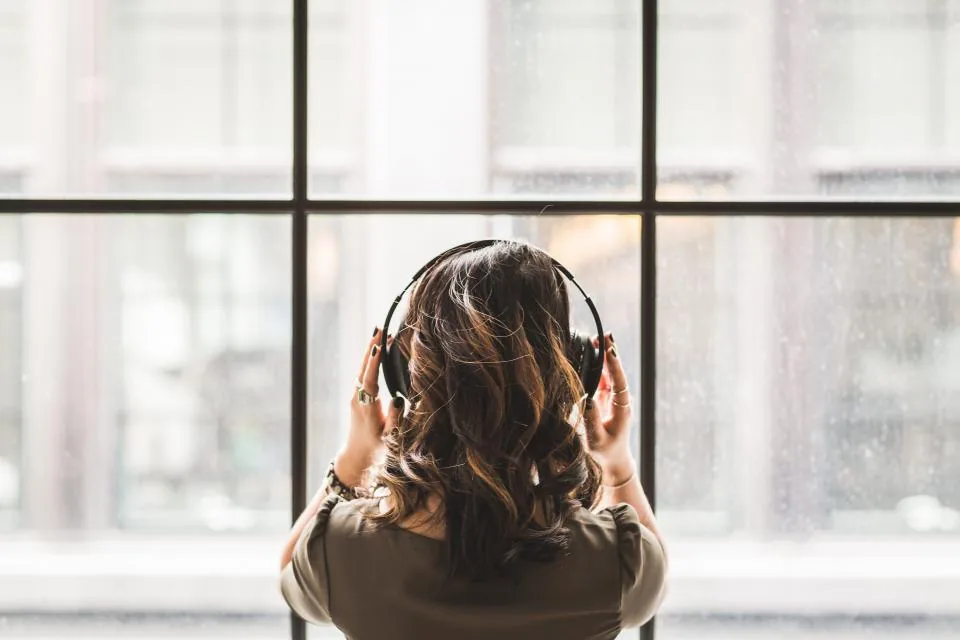
One note on listening: playing affirmations through the night while you sleep isn't well supported, and audio can make sleep lighter. Listen while you're awake, then let the room go quiet. Our affirmations before sleep guide has a calmer bedtime routine.
What is the best time of day to say affirmations?
The three best moments are first thing in the morning, right before a moment that usually knocks you off balance, and just before sleep. You don't need all three every day.
- Morning. Before you open your messages, so the first sentence of your day is one you chose. Our morning affirmations are written for exactly this.
- Before a trigger. The meeting, the date, the call you've been dreading. Ten seconds and one line before you walk in. For nervous moments, try our confidence affirmations or affirmations for anxiety.
- Before sleep. When the house is quiet and your mind is softer.
Why mornings and nights? Practically, they're easy to tie to things you already do, like making coffee or brushing your teeth, and tying a new habit to an existing cue is one of the most reliable ways to make it stick. Many manifesters also love the drowsy minutes before sleep for another reason. They describe it as a "theta" or in-between state, when the mind is less guarded and a line can sink in more deeply. Science hasn't shown that affirmations work better in that state, but it is a calm, private moment, and calm is a good place to practise from.
Does saying affirmations more often make them work better?
Up to a point. More repetitions make a line feel familiar, but after a few minutes a day you get diminishing returns. Feeling it once beats rattling it off fifty times.
Repetition does change how a sentence feels. Since the 1970s, researchers have found that people rate statements they've seen before as more likely to be true than new ones, simply because they're familiar (Hasher, Goldstein & Toppino, 1977). That's part of why repeated affirmations start to feel natural.
But repetition has a limit. If a line feels like a lie, saying it more can make you argue back harder. In one well-known study, people with low self-esteem who repeated "I'm a lovable person" felt worse afterwards (Wood, Perunovic & Lee, 2009), although a later replication didn't find the same effect. The safe lesson: pick lines you can say without flinching. Our guide on how to write affirmations shows how, and if you're struggling to believe any of it, read how to manifest when you don't believe it.
This is also where the spiritual view and the research agree. Manifesters often say the universe responds to how you feel, not to how many times you say something. Psychology would put it as attention and emotion: a line you actually feel engages you, a line you mumble doesn't. Either way, slow down, breathe and let one repetition count.
How long until you notice a difference?
Most people notice a small change in how a line feels within one to three weeks of daily practice. Making it automatic takes longer, often around two months.
In a well-known study that followed 96 people building a simple daily habit, it took a median of 66 days for the habit to feel automatic, with a wide range from 18 to 254 days (Lally et al., 2010). Affirmations are a habit too. The first change is usually subtle: a line that felt awkward starts to feel neutral, then a little bit true. You catch yourself thinking it without trying.
Manifesters talk about this in terms of divine timing and trust. Things shift when they shift, and pushing for a deadline can make you tense. You don't have to choose between the two views. Give your practice a fair trial of at least three to four weeks before you judge it, and look for quiet evidence along the way. Our list of signs your manifestation is coming describes what that evidence tends to look like.
Should you say "I" or "you"?
Both work. "I" is the classic form. "You", or your own name, can help on stressful days, because it creates a little distance from the feeling.
In a set of studies, people who coached themselves using "you" or their own name before a stressful speech felt less anxious and performed better than those who used "I" (Kross et al., 2014). Try "You can do this calmly" next to "I can do this calmly" and notice which one your body believes today.
What does a simple daily affirmation schedule look like?
A simple schedule ties each repetition to something you already do. Here's one that takes about five minutes in total.
- Choose one to three lines for the next two to four weeks. Write them somewhere you'll see them.
- Attach them to anchors: coffee, a commute, brushing your teeth. The anchor is the reminder.
- Say each line three times, slowly, on the out-breath. Pause after each one.
- Add one feeling. Picture a small moment where the line is already true and let yourself feel it for a breath.
- Review on Sunday. Keep the lines that land, rewrite the ones that don't.
| When | What | Time |
|---|---|---|
| Morning, with coffee | Your main line, 3 times out loud | 1 min |
| Before your hardest moment | One short line in your head | 10 sec |
| Afternoon reminder | Read today's line, take one slow breath | 30 sec |
| Evening, in bed | Your main line on 3 out-breaths, then one thing you're grateful for | 2 min |
If you like to scroll through a few lines instead of repeating one, the full-screen affirmation feed in Sena lets you read one line at a time, written for the goal you're working on.
12 short affirmations made for repeating (1–12)
Short lines are easier to say on one breath and easier to remember. These are written to feel believable from day one.
- Each repetition is a small vote for me.
- I say it slowly, and I mean it more.
- One kind sentence, as many times as I need.
- My words are getting easier to believe.
- I practise this thought until it feels like home.
- Steady words, steady steps.
- I return to this line whenever I drift.
- A little every day is enough for me.
- I can say it softly and still mean it.
- This sentence is becoming part of my day.
- I come back to myself, again and again.
- You can say it once more, and kinder.
What if you forget or miss a day?
Nothing is lost. Pick it up at the next natural moment and carry on.
In the habit study above, missing a single day didn't meaningfully slow people down (Lally et al., 2010). What mattered was coming back. Many manifesters put it more gently: your practice is a relationship, not a test, and the universe doesn't keep score. Guilt is a heavier feeling than the one you're trying to grow, so skip it. Read your line once, breathe, and you're back.
If you keep forgetting, the problem is usually the cue, not you. Move your affirmation to a spot you can't miss: your Lock Screen, the bathroom mirror, the first page of your journal.
Questions people ask
How many times a day should I say affirmations?
Two or three short moments a day is a good place to start: once in the morning, once when you need it during the day and once before sleep. Say one to three lines a few times each moment. Doing this every day for several weeks matters more than saying them a hundred times in one sitting.
Is it better to say affirmations out loud?
Out loud is a little more memorable, because speaking a word helps it stick better than reading it silently. But a whisper, a line in your head on the out-breath or a sentence written in a notebook all count. Choose the way you will actually keep doing.
How long does it take for affirmations to work?
Many people notice a small shift in how a line feels within one to three weeks of daily practice. Turning it into an automatic habit usually takes longer. In one well-known study, daily habits took a median of 66 days to feel automatic, with a range from 18 to 254 days.
What happens if I miss a day of affirmations?
Nothing is undone. In habit research, missing a single day did not meaningfully set people back. Many manifesters say the same thing in their own words: the practice is a relationship, not a test. Pick it up again at the next natural moment.
Should I say the same affirmation every day?
Yes, for a while. Repeating the same one to three lines for two to four weeks lets them become familiar and feel more natural. When a line stops landing, or starts to feel completely true, swap it for a new one.
Sources
- Cepeda, N. J., Pashler, H., Vul, E., Wixted, J. T., & Rohrer, D. (2006). Distributed practice in verbal recall tasks: A review and quantitative synthesis. Psychological Bulletin, 132(3), 354–380.
- MacLeod, C. M., Gopie, N., Hourihan, K. L., Neary, K. R., & Ozubko, J. D. (2010). The production effect: Delineation of a phenomenon. Journal of Experimental Psychology: Learning, Memory, and Cognition, 36(3), 671–685.
- Hasher, L., Goldstein, D., & Toppino, T. (1977). Frequency and the conference of referential validity. Journal of Verbal Learning and Verbal Behavior, 16(1), 107–112.
- Lally, P., van Jaarsveld, C. H. M., Potts, H. W. W., & Wardle, J. (2010). How are habits formed: Modelling habit formation in the real world. European Journal of Social Psychology, 40(6), 998–1009.
- Wood, J. V., Perunovic, W. Q. E., & Lee, J. W. (2009). Positive self-statements: Power for some, peril for others. Psychological Science, 20(7), 860–866. See also a later replication attempt.
- Kross, E., Bruehlman-Senecal, E., Park, J., et al. (2014). Self-talk as a regulatory mechanism: How you do it matters. Journal of Personality and Social Psychology, 106(2), 304–324.
A few words, every day.
Sena brings your affirmations to you: gentle reminders at the hours you choose, today's line on your widgets and a feed written for your goals.
Get SenaKeep reading

Affirmations
How do you write affirmations that feel true?
A simple formula, seven steps and 30 examples, with the intuitive side and what the research adds.
Read
Affirmations
60 morning affirmations to start your day calm and clear
Short, believable lines for slow mornings, rushed mornings and everything in between.
Read